

Restaurant Marketing Strategies: What Should You Do First?
Book Your Free Growth & Story Discovery
It's Monday morning. Tuesday looks slow. The owner already has a list of things to try.
Post more on Instagram.
Fix your Google profile.
Run ads.
Send email.
Hire creators.
Start a loyalty program.
Shoot video.
Push promotions.
Get more reviews.
Build a better website.
Any one of those could help.
With ten possible moves, the owner still has one question: which one comes first?
The hard part isn't finding another idea. It's knowing which problem to work on first.
The simple answer: don't choose the tactic first. Find where people stop moving forward, then choose the move that fits.
Start With the Problem, Not the Channel
Stay with that slow Tuesday. Two restaurants can look at the same empty tables and say:
"We need more customers."
For one restaurant, hardly anyone finds it.
For another, plenty of people find it, read the reviews, look at the menu, and still choose somewhere else.
Same slow Tuesday. Different reason.
A third restaurant gets selected all the time, but its reservation page is frustrating on a phone.
A fourth gets plenty of first-time guests, but almost nobody comes back.
They can all say, "We need more customers."
But more Instagram posts would not solve all four.
Neither would more ads.
Neither would a new website.
Neither would video.
So the first move has to match the reason.
One Complaint Can Hide Seven Different Problems
Foodbox uses the Customer Choice Cycle to break "we need more customers" into seven places to look:
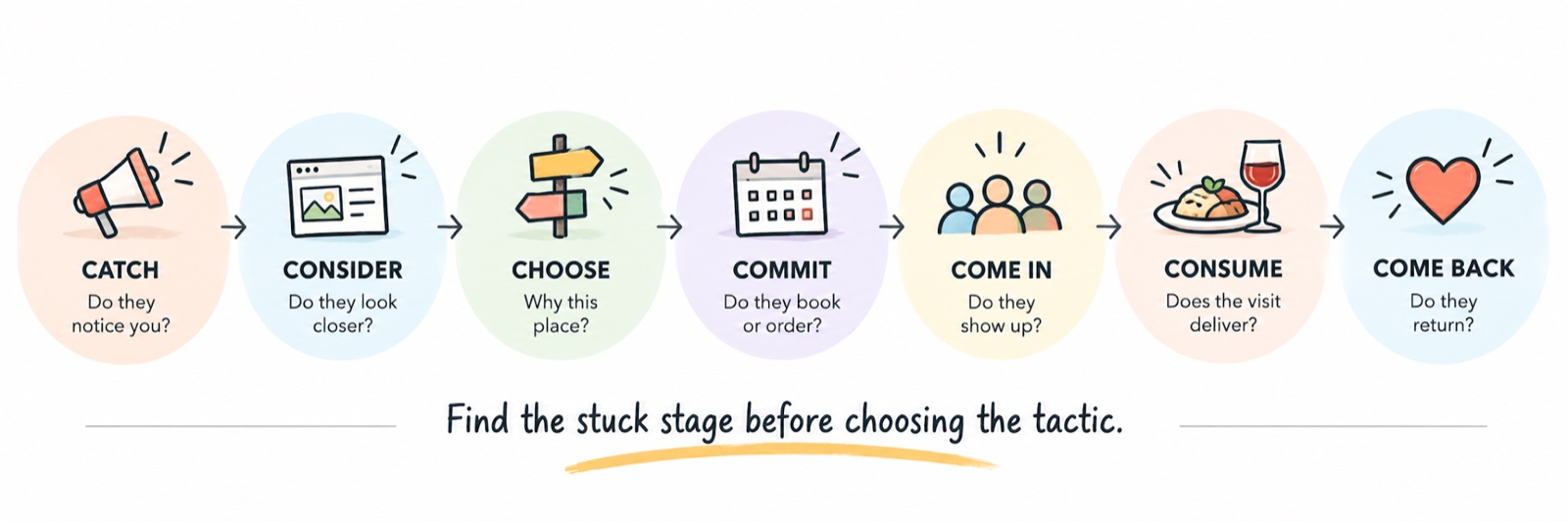
Use this to decide where to look, not as proof of why a guest acted.
Where are people most likely getting stuck?
If you don't know yet, use the stages below to see what each slowdown can look like and what kind of response fits.
Restaurant Marketing Strategies by Customer Choice Stage
Now match the stuck point to the first move.
Catch: Help the Right People Find You
If too few of the right people are finding the restaurant, work on getting found.
Restaurant marketing strategies at this stage might include:
Local search and Google Business Profile
Local partnerships
PR
Creator relationships
Paid local advertising
Events
Social distribution
Neighborhood outreach
Ask one thing:
Are enough of the right people seeing the restaurant?
If not, help more of the right people find you.
If they already are, keep moving.
Consider: Give Them a Reason to Look Closer
Someone sees your restaurant in search, on social, in a recommendation, or on a map.
Now what?
They may open the menu.
Look at photos.
Read reviews.
Check the website.
Scan Instagram.
Ask someone who has been there.
At this stage, restaurant marketing is less about yelling louder and more about making the next click worth it.
That might mean:
A clearer menu
Better restaurant photography
Current room photos
A website that answers the obvious questions
Strong review coverage
A chef explaining one dish
A clearer sense of the occasion
Content that shows what regulars already know
This is where owners sometimes discover that they do not need more content.
They need the right information to be easier to see.
Choose: Show Why This Restaurant
Consider and Choose are close, but they are not the same.
Consider means:
"This looks interesting."
Choose means:
"Let's go there."
If several restaurants look good, your marketing has to help the guest see why this one fits the night.
This can come from Chef, Place, Plate, and People.
Maybe the chef refuses to shortcut a specific preparation.
Maybe the room is the reason people choose it for a birthday.
Maybe one dish has a story that disappears when it becomes one line on the menu.
Maybe longtime servers are a major part of why guests return.
Restaurant branding, photography, video, reviews, press, social, and website copy can all help.
The channel only carries the message.
The work is making the strongest reason to choose the restaurant visible before the guest decides.
Commit: Make the Next Step Easy
Sometimes the restaurant already won the comparison.
Then the guest reaches the reservation page.
It loads badly.
The button is hard to find.
The hours look different in two places.
The online menu is outdated.
The phone number does not work.
The guest is not sure whether the restaurant takes walk-ins.
They already chose you. Sending more people to the same broken path won't help.
Fix the booking path before you buy more traffic.
Sometimes the first move is unglamorous:
Clear reservation buttons
Mobile-friendly booking
Accurate hours
Current menus
Direct ordering links
Simple calls to action
Consistent listings
Clear large-party instructions
A small fix here may matter more than a new campaign.
Come In: Reduce the Gap Between Booking and Arrival
A reservation isn't the end of the job.
A guest can still cancel, no-show, get confused about parking, arrive late, or discover a policy they did not expect.
That might mean:
Reservation confirmations
Day-of reminders
Parking or entrance instructions
Dress-code information
Deposit or cancellation terms
Large-party instructions
A simple message that sets expectations
This is not about sending more messages.
Answer the question before the guest has to ask it.
Consume: Make Sure the Promise Matches the Visit
This is where marketing has to know when to get out of the way.
If reviews repeatedly mention a service problem, misleading menu information, long waits, or something else inside the actual visit, more promotion may not be the first move.
If the repeated complaint is happening inside the visit, fix that before promoting harder.
Fix what the guest keeps running into.
Marketing can help set better expectations, explain a format, prepare someone for a tasting menu, or clarify what kind of room they are walking into.
But it cannot replace the meal or the hospitality.
Come Back: Give a Great Visit Somewhere to Go Next
A guest comes in.
The food is great.
The team takes care of them.
They leave happy.
Then what?
If the restaurant disappears from their life, the next visit depends on memory, habit, or chance.
Restaurant marketing strategies after the visit might include:
SMS
Loyalty
Events
Birthday or anniversary messages
Seasonal menu announcements
New stories worth following
A reason to return on another occasion
You don't need to message people constantly.
Make the restaurant easier to remember when the next restaurant decision comes around.
Now go back to that slow Tuesday. Which stage looks most likely?
A Simple Way to Decide What Should Happen First
Go back to the slow Tuesday. Don't solve it yet.
Start with what you can actually see.
Step 1: Write the complaint in plain language
Examples:
"We are slow on Tuesdays."
"People visit the website but do not reserve."
"Guests love us once they come in, but first-time traffic is weak."
"We have a lot of first-time diners and not enough regulars."
"People keep asking questions that are already on the website."
Do not solve it yet.
Just write what appears to be happening.
Step 2: Put it somewhere on the Customer Choice Cycle
Catch?
Consider?
Choose?
Commit?
Come In?
Consume?
Come Back?
You may not know for sure.
That is fine.
You only need the best place to check first.
Step 3: Look for something observable
Do not rely only on a feeling.
Look at what you can actually see.
Search visibility.
What people do on the website.
Menu clicks.
Reservation starts and completions.
Review language.
Common guest questions.
No-shows.
Repeat visits.
Email signups.
Return frequency.
Use whatever information your restaurant actually has.
If the numbers are incomplete, say so. Don't pretend they prove more than they do.
Step 4: Choose one change
One.
If Commit appears weak, simplify the booking path.
If Choose appears weak, show one reason regulars already love the restaurant.
If Catch looks weak, help more of the right people find you.
If Come Back appears weak, give a strong first-time guest a sensible next reason to return.
You're not trying to finish marketing.
You're trying to stop changing five things at the same time and then wondering what worked.
Step 5: Watch one thing
Changed the booking page?
Watch completed reservations where your system can measure them reliably.
Improved local search information?
Watch profile actions, calls, directions, website visits, or reservations where available.
Started an email follow-up?
Watch signups, clicks, and, where you can connect it reliably, whether those people return.
Created a story around a signature dish?
Watch whether people finish it, save it, ask about the dish, click through, or mention it.
Watch the thing your change was supposed to affect.
If More Than One Stage Looks Weak
That will happen. Don't turn it into seven simultaneous projects.
Ask two questions:
Which problem has the clearest evidence?
Which problem is stopping people from moving forward?
Fix the blocker first, then work forward.
A Restaurant Marketing Plan Is an Order of Operations
By now, "we're slow on Tuesdays" should have turned into something more specific.
A marketing calendar isn't the plan. The plan should say what you're trying to change and why that comes first.
That could mean:
Fix the Google listing before buying local ads.
Fix the mobile reservation path before increasing traffic.
Make the strongest reason to choose you visible before paying to put it in front of more people.
Fix a repeated guest complaint before promoting the restaurant harder.
Create a simple return path before chasing another first-time guest.
A tactic belongs in the plan only if you can say what it's supposed to change.
You may still use social media, email, reviews, ads, creators, events, video, photography, loyalty, SEO, and promotions.
But they can't all be first.
What should actually happen first?
Want Another Set of Eyes on Your Restaurant Marketing?
You know the restaurant from the inside: what the food tastes like, what the team is trying to do, and why regulars come back.
A potential guest sees only what's in front of them before they choose.
That is why Foodbox starts with a free Growth & Story Discovery.
Before the conversation, we look at what a potential guest can see from the outside: search, website, menu, reviews, social, reservation path, current content, and the restaurants they're likely comparing you with.
Then we spend about 20 minutes with you.
You tell us what we got right, what we got wrong, and what we cannot see from the outside.
We're not there to force video, ads, or content into the answer.
We're there to answer one question:
What should actually happen first?
Maybe the team can fix something tomorrow.
Maybe not enough of the right people are finding you.
Maybe the reservation path is the issue.
Maybe your guests already love something the marketing barely shows.
Maybe a deeper plan or production makes sense.
Maybe it does not.
The Discovery is free, and there is no obligation to buy anything.
Go back to Monday morning and that list of ten tactics. Before you add another one, let's figure out which problem to work on first.