
How to Make Your Restaurant Stand Out Before a Guest Visits
Book Your Free Growth & Story Discovery
Picture somebody trying to decide where to eat tonight.
They have three restaurants open on their phone.
All three look good. All three have strong reviews. All three have food they'd probably enjoy.
But they're only going to choose one.
Somewhere in that comparison, one restaurant becomes: "That's where we're eating tonight."
There's a big difference between "I know that place" and "That's where we're eating tonight."
Being seen isn't the same thing as being chosen.
If you're asking how to bring in business to a restaurant, it's tempting to jump straight to another promotion, another ad campaign, another social post, or another video. Sometimes that's right.
But sometimes they already found you.
Before you add more marketing, look at what a first-time guest can actually see about your restaurant before they visit.
The simple answer: make the strongest reasons to choose your restaurant visible before the guest decides. Then find where people stop moving forward.
First, Find Where the Guest Is Getting Stuck
Foodbox maps the full guest journey through seven stages. For this article, four of them matter before the visit: Catch, Consider, Choose, and Commit.
The Four Pre-Visit Stages at a Glance
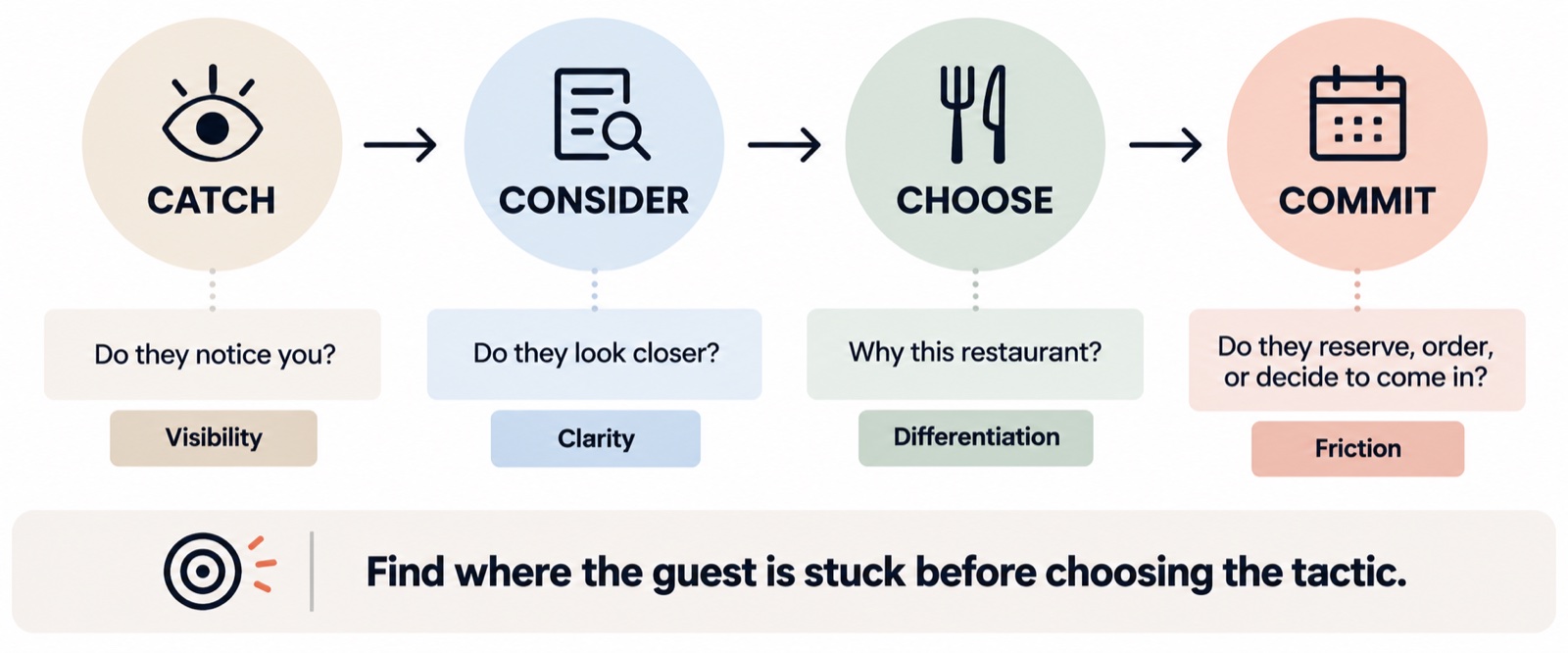
Use the map as a question, not a verdict. A guest can stop for more than one reason. The point is to stop treating every slowdown like an awareness problem.
Same complaint. Different problem. Different next move.
Go back to the guest with three restaurants open. One place may never get noticed. Another gets a closer look but gives the guest no strong reason to keep going. A third gets chosen, but the booking process becomes frustrating. Same outcome: no visit. Different reason.
That is why a list of restaurant marketing ideas is not a strategy by itself. Branding, social, reviews, paid media, email, promotions, and analytics can all be useful. They just solve different jobs.
What Can a Guest Actually See Before Visiting?
Go back to the person on the couch. They're not in your dining room. They can't taste the food, hear the room, or meet the people yet.
Great food can speak for itself once someone tastes it. The problem is they have to choose you before the first bite.
Your regulars may know which dish to order, how the room feels, who remembers their name, where to park, and what kind of night the restaurant is good for.
A first-time guest has to make the choice without any of that.
They may only have your Google listing, website, menu, reviews, photos, social media, and reservation or ordering path.
That is the version of the restaurant they're choosing from.
Look at those touchpoints as a stranger.
Does your menu simply list dishes, or can someone tell what you do especially well?
Do your photos show only finished plates, or do they also reveal the room, the people, the energy, and the care behind the food?
Does your website explain what kind of experience someone is choosing?
Do your reviews repeatedly mention something your own content barely talks about?
Can someone quickly tell whether your restaurant fits the occasion they have in mind?
And once they decide they want to come, is the next step obvious?
The goal isn't to make every page say more. It's to make the strongest reasons to choose you easier to see.
Compare What You Know With What the Guest Can See
Now change seats. You're no longer the guest on the couch. You're the owner standing inside the restaurant.
You know what regulars order, how the room feels, what guests compliment, and the hundreds of small choices that shape the experience.
The first-time guest has only what shows up before the visit.
Put those two views next to each other and ask:
What can a new guest clearly see before visiting?
What do your best customers love after visiting that wasn't obvious before?
The gap between those answers is what a first-time guest doesn't have yet.
Picture one of those restaurants on the phone. Regulars know the chef refuses to shortcut a signature dish. They know the room gets lively after 7. They know a longtime server remembers names. But online, the guest sees "fresh ingredients," a few plate close-ups, and a menu.
Nothing is wrong with the restaurant. The strongest reasons people love it simply never enter the comparison.
That's the gap to solve. Not "What should we post?" but "What part of the real restaurant would make this guest want to know more?"
Restaurant Differentiation: Four Places to Look
If the gap is that important parts of the restaurant never make it into the comparison, you don't need to invent a slogan, gimmick, or louder campaign.
Look for what is already there in four parts of the real restaurant: Chef, Place, Plate, and People.
Chef is more than a résumé. What does the chef believe about the food? What won't they shortcut? What ingredient, technique, tradition, or point of view changes the way the menu is made?
Place is more than "warm and inviting." What actually happens in the room? Who comes here? What does the restaurant feel like during service? Is it built for a quiet two-top, a family meal, a celebration, a neighborhood regular, or something else?
Plate is more than a beauty shot. Why does this dish exist? Why this preparation? Why this ingredient? What would someone appreciate more if they knew what went into it?
People are the part of the experience that many restaurant feeds barely show. Who welcomes guests? Who has been on the team for years? What small rituals or acts of hospitality make people feel known?
These aren't four things to invent. They already exist inside the restaurant.
You don't need to be different in every way. You need the differences that matter to be visible before the guest decides.
Branding can package those differences. Social media can distribute them. Reviews can reinforce them. But all three still need something real to carry.
Run a 15-Minute Outside-In Restaurant Audit
Now put your own restaurant into that same three-restaurant screen.
Set a timer for 15 minutes. What does a stranger see first? What would make them keep looking? Where might they stop?
This won't tell you everything. It will give you one place worth checking before you spend time or money changing things.
Step 1: Search for your restaurant
Don't start from your bookmarks or admin dashboard. Search the restaurant name and the type of experience or cuisine a guest might use to discover you. Notice what appears first.
Step 2: Open the places a guest is likely to check
Use your phone. Open the same things a guest would: Google, your website, menu, reviews, social presence, and reservation or ordering path. Don't ask whether you personally like them. Ask what a first-time guest can tell without your help.
Step 3: Write down three things a guest can tell right away
These should be specific. "Great food" isn't specific. "Wood-fired steaks in a lively room built for groups" is specific. "Family-owned Filipino bakery with fresh pandesal every morning" is specific.
Step 4: Write down three things your regulars love that aren't obvious online
Use real guest comments, staff conversations, reviews, repeated questions, and the things people tell you after they become customers.
Step 5: Pick one gap
Not five. One.
And if a stage looks strong, leave it alone. Don't spend energy fixing a part of the guest journey that appears to be doing its job.
If someone can't tell what kind of experience the restaurant offers, fix that.
If a signature dish looks ordinary without context, explain it.
If guests rave about the team but the team is invisible online, show the people.
If people want to book but the reservation path is confusing, fix the path before you create another campaign.
What If the Real Problem Is Getting Noticed?
Sometimes the answer is simpler: your restaurant never makes it onto the guest's phone in the first place.
If the rest of the path looks strong, discovery really may be the problem.
If Catch looks weak, focus on ways to help more of the right people find you: local search, partnerships, PR, creators, paid media, events, or social distribution.
If Consider or Choose looks weak, more reach may just send more people into the same unclear choice.
If Commit is weak, fix the reservation, ordering, or arrival friction.
Video may help. Photography may help. Website changes may help. Email may help. Promotions may help.
But they can't all be first.
Find where the guest is getting stuck. Then decide what to do.
Choose One Improvement to Make First
The best next move should be small enough to execute and specific enough to learn from.
You might rewrite the description of one signature dish.
You might add one section to the website explaining what the dining room feels like and who it's best for.
You might show the chef explaining why one dish is made that way.
You might replace generic room photos with images that show the restaurant during actual service.
You might take the most repeated compliment in your reviews and make sure a new guest can see that strength before visiting.
You might simplify the reservation instructions.
The goal isn't more content for the sake of content.
The goal is to make one part of the choice easier.
Measure What Changes
Pick one thing to watch after you make the change. Don't measure everything just because the dashboard can.
Changed the menu page? Watch menu clicks or where people go next from that page.
Changed the reservation path? Watch reservation-page visits and completed reservations where your systems can reliably attribute them.
Created a video about a signature dish? Watch completion, saves, meaningful comments, or clicks to the next step.
Added an email opt-in? Measure opt-ins.
The point isn't to turn every metric into proof. It's to see whether people did anything differently.
Make one change. Watch what happens. Learn. Then decide what deserves attention next.
Want Another Set of Eyes on the Guest Journey?
Looking at your own restaurant from the outside is hard because you already know it from the inside.
Foodbox doesn't know it from the inside. That's the point. We can see what a potential guest sees before you add the context only the operator knows.
The free Growth & Story Discovery puts both views together.
Before the conversation, we take a quick outside-in look at what a potential guest can see: Google, your website, menu, reviews, social, the reservation path, and the restaurants they're likely comparing you with.
We bring two or three specific things we noticed. Then we spend about 20 minutes with you. You tell us where we're right, where we're wrong, and what we can't see from the outside.
The goal isn't to sell you video. The goal is to answer one question:
What should actually happen first?
Maybe your team can fix something tomorrow. Great. Maybe a deeper plan or production makes sense. Maybe it doesn't.
The Discovery is free, and there's no obligation to buy anything.
Go back to those three restaurants on the phone. One gets chosen. Before you spend another dollar guessing what yours needs next, let's look at the restaurant together and figure out what should happen first.